





Western Forest Products has joined the International ThermoWood Association (ITWA), an important step in bringing our thermally modified Hem-Fir products to market. Membership connects Western to an established production and quality-control framework, shared technical knowledge, and the internationally recognized ThermoWood® trademark.
Supporting Commercial Growth with a Recognized Global Trademark: ThermoWood®
ThermoWood® is a registered trademark that identifies wood manufactured using a defined thermal modification process. ITWA owns the trademark and is responsible for its use and the quality system that supports it. ThermoWood® is not a company or a generic name for all thermally modified wood.
Thermal modification includes several technologies that use controlled heat to change wood properties. This process involves different types of equipment, processing conditions, and operational parameters. Within this broader category, ThermoWood® stands out as it combines a specific manufacturing method with established quality standards and verification protocols.
A Pioneer In Commercial Thermal Modification.
ThermoWood’s origins date back to the early 1990s when Finnish forest product companies collaborated with VTT, Finland’s Technical Research Centre, to develop thermal modification for industrial production. Their objective was to enhance wood performance through heat, offering alternatives to chemically treated wood and certain tropical wood products.
In 1994, the thermal modification process was patented, and ThermoWood® was registered as a trademark. The International ThermoWood Association (ITWA) was established in 2000 and acquired ownership of the trademark in 2001. These steps transformed a research-driven technology into a well-organized commercial system.
ThermoWood’s category leadership is built on early industrial development, ongoing research, and a robust international quality framework. By 2024, annual ThermoWood® production surpassed 280,000 cubic meters. This commercial experience provides a strong foundation for manufacturers creating new products today.
How The Process Changes Wood.
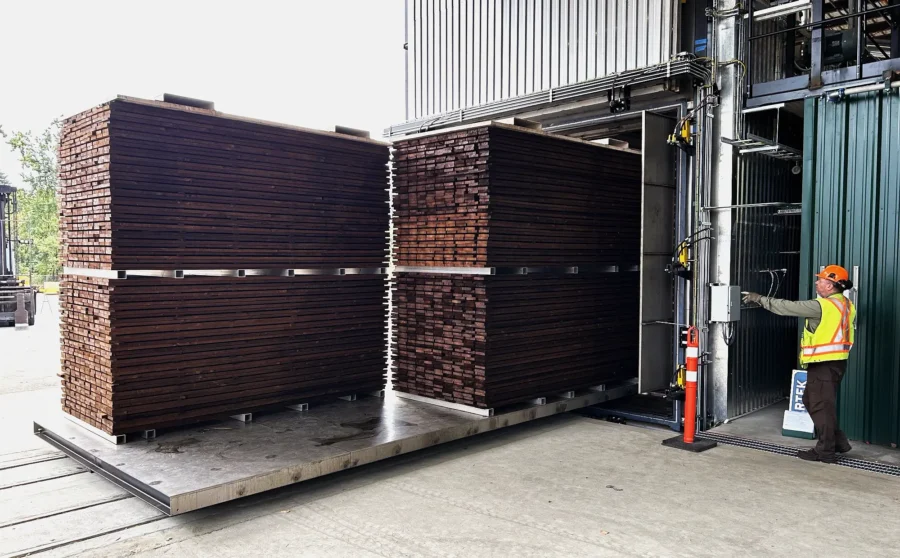
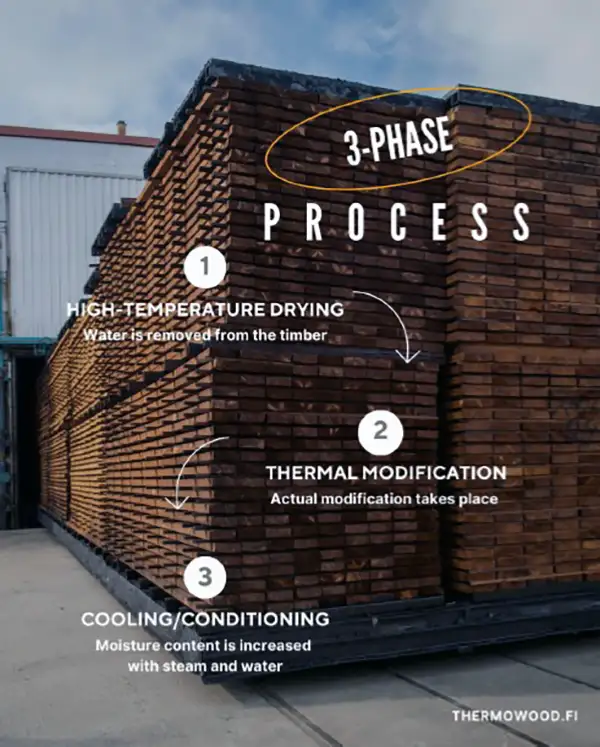
The ThermoWood® process uses controlled heat and steam, without added chemicals. Wood moves through stages of drying, thermal modification, and cooling and conditioning.
Heating changes components within the wood’s cell walls, including hemicelluloses, which influence how wood interacts with moisture. These changes reduce moisture absorption and improve resistance to fungal decay. Steam helps protect the wood during treatment.
The result is a permanent change in the material itself. While ordinary kiln drying removes moisture, thermal modification changes how the wood responds when it reabsorbs moisture.
What Benefits Does It Offer?
For distributors and customers evaluating thermally modified wood, the principal benefits include:
- Improved dimensional stability. Reduced moisture uptake means less swelling and shrinkage as conditions change.
- Enhanced decay resistance. Thermal modification improves biological durability, with performance depending on the species and treatment.
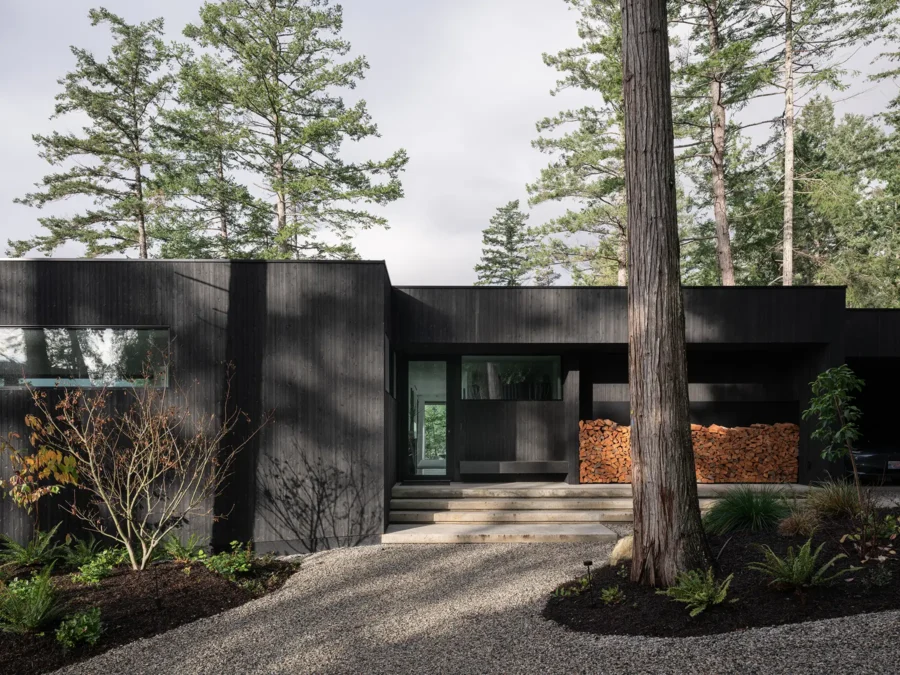
- Colour throughout the wood. The treatment develops a darker tone throughout the material.
- Modification without added chemicals. Heat and steam produce the changes.
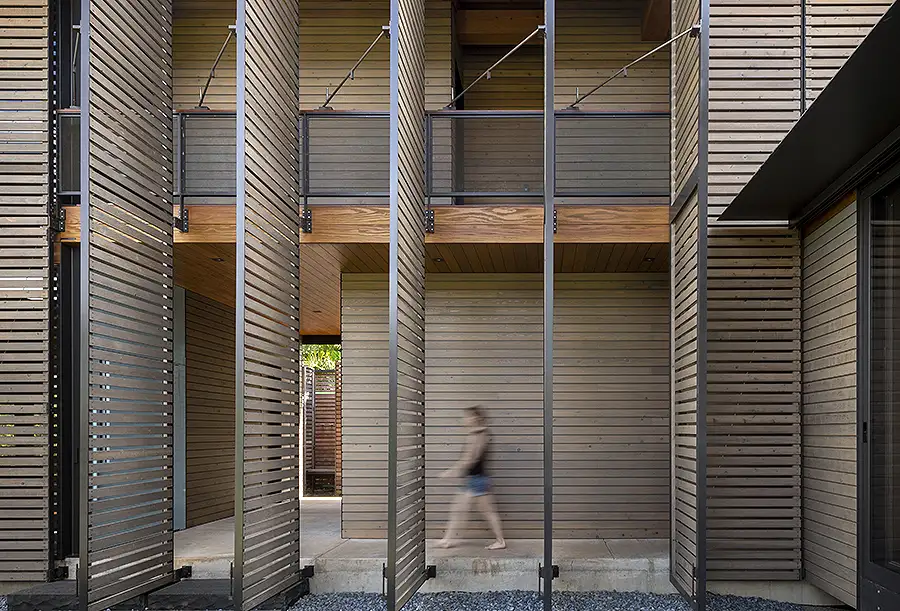
ThermoWood® has two treatment classes. Thermo-S emphasizes improved dimensional stability, while Thermo-D provides improved stability with greater durability for more demanding exterior applications such as cladding.
Matching the product to its application remains essential. Thermal modification can reduce strength, and untreated surfaces will weather toward gray outdoors. Treatment class, product-specific performance, installation, and finishing guidance help customers make informed choices.
A Name Supported By Quality Controls.
The ThermoWood® system connects production requirements with independent oversight. Manufacturers maintain documented quality-control procedures, while an accredited external inspection body audits production plants at least annually. An approved external laboratory also tests finished products annually, using samples selected by the auditor’s representative.
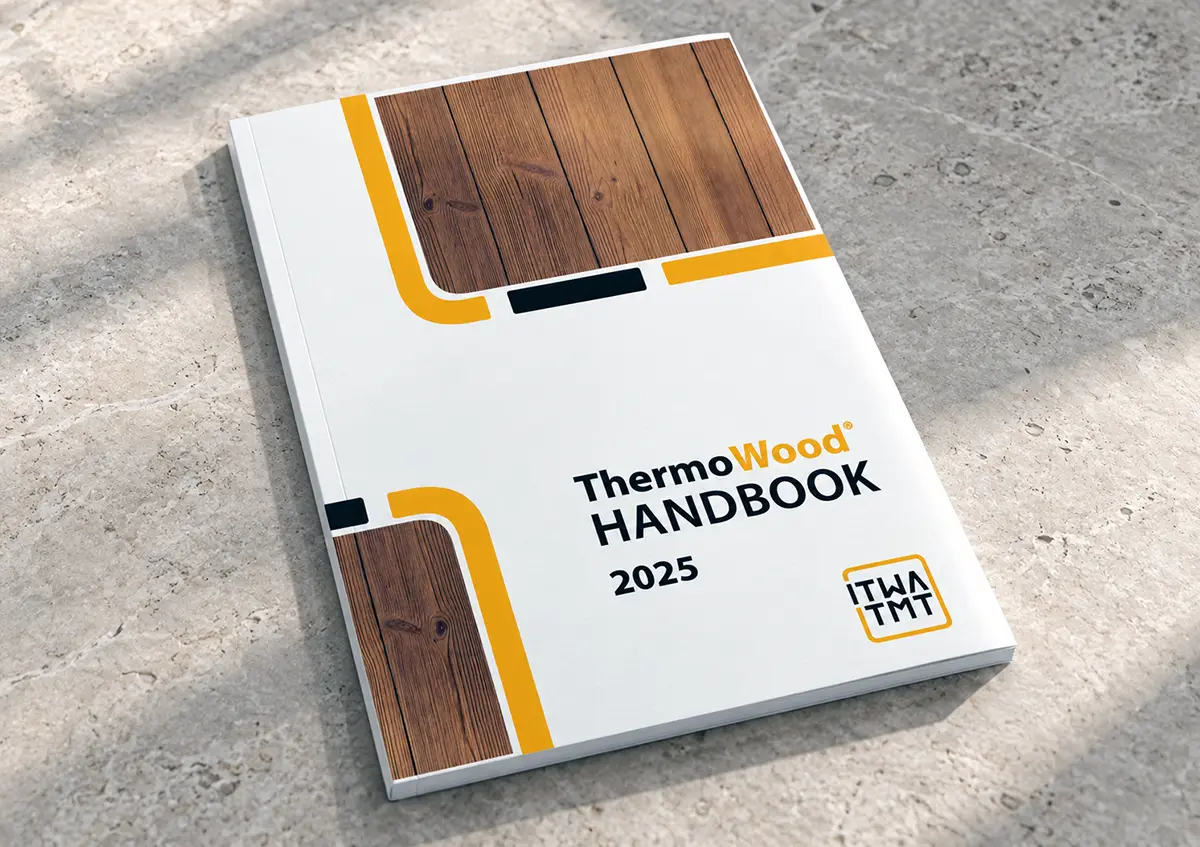
For distributors, this provides a recognizable framework for evaluating how products are manufactured and checked. It also supports clearer conversations with customers about consistency, quality assurance, and the evidence behind a product.
Why Western Has Joined.
For Western, ITWA membership supports the transition from product development to commercial production. It provides an established framework for process control, quality assurance, documentation, and verification as we build our thermally modified Hem-Fir portfolio.
Membership also gives Western access to shared research and an international network of producers, equipment manufacturers, and technical specialists. ITWA members collaborate on research, quality control, and standardization, allowing manufacturers to draw on industry-wide experience.
These resources complement the extensive product-specific testing and development already underway at Western. Our work combines the established ThermoWood® process with the characteristics of Western Hemlock and Amabilis Fir and documents how the resulting products perform in their intended applications.
Building A Dependable Hem-Fir Portfolio.
As an ITWA member, Western is authorized to use the ThermoWood® trademark in accordance with the association’s requirements. That gives our developing portfolio a recognized identity supported by a defined production system.
For our distribution partners, the value lies in what this helps Western deliver: consistently manufactured products, technical documentation, and a clear basis for communicating performance to customers.
Joining ITWA brings coastal B.C. Hem-Fir into an established international thermal modification community. It supports our goal of turning a promising product opportunity into a reliable, scalable wood product portfolio for the North American market.